

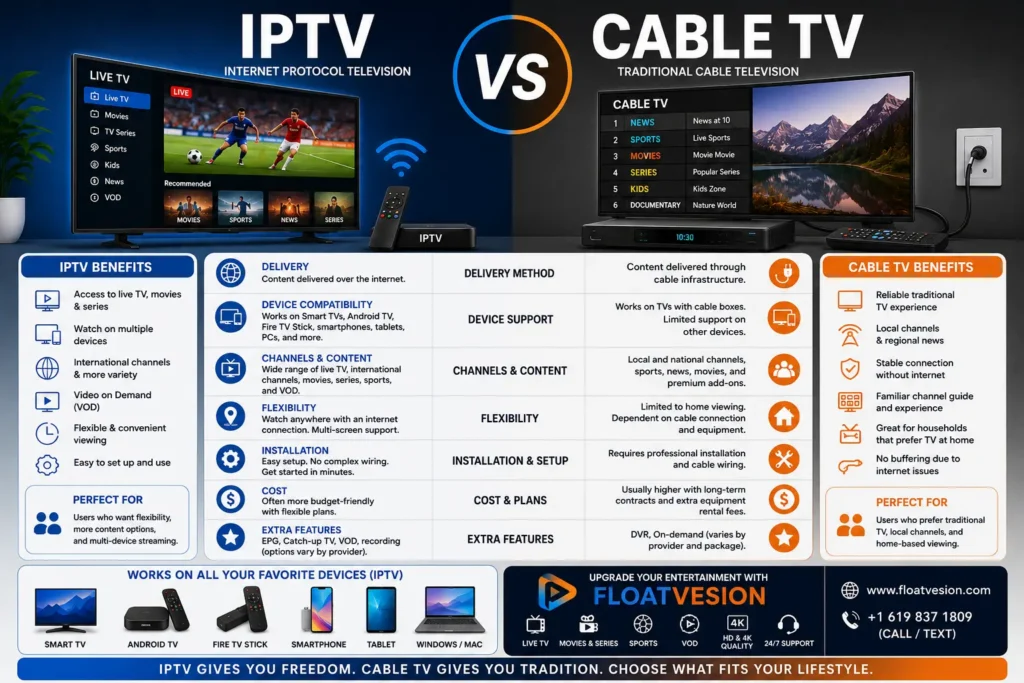
IPTV vs Cable TV: Which Is Better for Your Entertainment?
Television has changed dramatically over the past decade. While traditional cable TV was once the standard for home entertainment, many viewers are now exploring IPTV as a flexible alternative that delivers content through an internet connection instead of coaxial cables.
When comparing IPTV vs Cable TV, the best option depends on your viewing habits, preferred devices, and the type of content you enjoy. Some people prioritize live television and local channels, while others value flexibility, international programming, and the ability to watch from almost anywhere.
This guide compares IPTV and Cable TV to help you understand how they work, their key differences, and which option may better suit your entertainment needs.
What Is IPTV?
IPTV (Internet Protocol Television) is a technology that delivers television programming over the internet rather than through satellite or traditional cable infrastructure.
Instead of relying on a cable connection, IPTV streams content directly to compatible devices using your internet connection.
Depending on the provider, IPTV services may include:
- Live TV channels
- Movies
- TV series
- Sports
- News
- Kids’ entertainment
- Video on Demand (VOD)
- Electronic Program Guide (EPG)
- Catch-up TV (where available)
One of IPTV’s biggest advantages is its compatibility with a wide variety of modern devices, making it easy to enjoy entertainment wherever you have internet access.
What Is Cable TV?
Cable TV is a traditional television service delivered through a network of coaxial or fiber-optic cables installed by a cable provider.
For decades, cable television has been one of the most common ways to watch:
- Local channels
- National TV networks
- Sports channels
- News
- Movies
- Entertainment
- Premium channel packages
Unlike IPTV, cable television generally requires a physical connection installed at your home, along with compatible equipment provided by the cable company.
IPTV vs Cable TV: Key Differences
Although both services provide television programming, they deliver content in different ways.
| Feature | IPTV | Cable TV |
|---|---|---|
| Delivery Method | Internet | Cable infrastructure |
| Live TV | Yes (provider-dependent) | Yes |
| Movies | Yes | Yes |
| TV Series | Yes | Yes |
| Sports | Often available | Often available |
| Video on Demand | Usually available | Available with many providers |
| Multi-Device Viewing | Common | Often limited |
| Mobile Viewing | Yes | Depends on provider |
| Installation | Usually simple | Professional installation may be required |
The exact features vary depending on the provider and subscription plan.
Content and Channel Selection
Content is often the deciding factor when choosing between IPTV and Cable TV.
IPTV
Many IPTV providers offer a broad mix of:
- Live television
- International channels
- Sports programming
- Movies
- TV series
- News
- Kids’ content
- Entertainment channels
- Music channels
- Documentary programming
Available channels vary depending on the provider and licensing arrangements.
Cable TV
Cable providers typically focus on:
- Local channels
- National broadcasters
- Sports packages
- Entertainment channels
- News networks
- Premium movie channels (depending on the package)
Channel availability depends on the cable operator and subscription tier.
Live Television
Live TV remains one of the strongest features of both IPTV and Cable TV.
IPTV
Many IPTV services provide live broadcasts of:
- Sports events
- News
- Entertainment
- International channels
- Lifestyle programming
Depending on the provider, additional features such as catch-up TV and cloud recording may also be available.
Cable TV
Cable television has traditionally been the standard for live broadcasting.
It generally includes:
- Local channels
- Regional news
- National networks
- Sports
- Live events
The exact lineup depends on the cable company and package selected.
Device Compatibility
One area where IPTV often offers greater flexibility is device compatibility.
IPTV Works With
- Smart TVs
- Android TV
- Google TV
- Amazon Fire TV Stick
- Apple TV
- Android smartphones
- iPhones
- Tablets
- Windows PCs
- Mac computers
This allows users to switch between devices while maintaining a consistent viewing experience.
Cable TV Works With
Cable television is commonly viewed through:
- Television sets
- Cable receiver boxes
- DVR units
Some cable providers also offer companion mobile applications, though supported features and device compatibility vary by provider.
Installation and Setup
Another important difference is the installation process.
IPTV
Getting started with IPTV is often straightforward:
- Choose a compatible IPTV subscription.
- Install an IPTV player or application.
- Enter your subscription credentials.
- Connect to the internet.
- Start streaming.
Most users can complete the setup in just a few minutes.
Cable TV
Cable TV often requires:
- Scheduling an installation appointment (depending on the provider)
- Cable wiring
- Receiver or set-top box installation
- Equipment activation
While many providers make the process simple, it typically involves more hardware than IPTV.
Streaming Quality
The quality of your viewing experience depends on several factors.
IPTV
Streaming quality is influenced by:
- Internet speed
- Wi-Fi stability
- Device performance
- IPTV provider quality
Many IPTV providers support:
- SD
- HD
- Full HD
- 4K (where available)
Cable TV
Cable TV quality depends on:
- Provider infrastructure
- Signal quality
- Equipment
- Channel availability
Many cable services also offer HD and 4K channels where supported.
Flexibility and Viewing Experience
One of the biggest differences between IPTV and Cable TV is how and where you can watch your favorite content.
IPTV
IPTV is designed for today’s connected lifestyle. Depending on your subscription and provider, you can enjoy your favorite entertainment on multiple compatible devices with an internet connection.
Benefits may include:
- Watch at home or while traveling
- Access on Smart TVs and streaming devices
- Continue watching on smartphones or tablets
- Flexible viewing across compatible devices
- Simple account management
This flexibility makes IPTV a popular option for users who prefer streaming without being tied to a single television.
Cable TV
Cable TV is generally centered around home viewing.
Advantages include:
- Reliable access through a dedicated cable connection
- Familiar channel navigation
- Consistent local programming
- Traditional television experience
Although some cable providers offer mobile applications, their features and availability vary.
IPTV vs Cable TV: Pros and Cons
IPTV Advantages
✔ Watch on multiple compatible devices
✔ Live television (provider dependent)
✔ Movies and TV series
✔ Sports programming
✔ International channels
✔ Video on Demand (VOD)
✔ Easy setup
✔ Flexible viewing from almost anywhere with internet access
IPTV Considerations
- Requires a stable internet connection.
- Streaming quality depends on network performance.
- Features differ between IPTV providers.
Cable TV Advantages
✔ Established television service
✔ Local and regional programming
✔ Familiar channel guide
✔ Reliable home viewing
✔ No dependence on home Wi-Fi for content delivery
Cable TV Considerations
- Usually requires professional installation or dedicated equipment.
- Less flexibility for viewing across multiple devices.
- Service availability depends on local cable providers.
IPTV vs Cable TV Comparison Table
| Feature | IPTV | Cable TV |
|---|---|---|
| Live TV | ✔ Yes | ✔ Yes |
| Movies | ✔ Yes | ✔ Yes |
| TV Series | ✔ Yes | ✔ Yes |
| Sports | ✔ Yes (provider dependent) | ✔ Yes |
| International Channels | ✔ Often available | Limited by package |
| Video on Demand | ✔ Usually included | Available with many providers |
| Smart TV Support | ✔ Yes | Via cable box or supported app |
| Fire TV Stick Support | ✔ Yes | Usually not directly |
| Android TV Support | ✔ Yes | Varies |
| Smartphone Viewing | ✔ Yes | Depends on provider |
| Tablet Viewing | ✔ Yes | Depends on provider |
| Computer Viewing | ✔ Yes | Limited by provider |
| Installation | Simple | May require installation |
| Portability | High | Low |
Internet Requirements for IPTV
Unlike cable television, IPTV relies on your internet connection.
For the best experience, these speeds are commonly recommended:
| Streaming Quality | Recommended Speed |
|---|---|
| SD | 5 Mbps |
| HD | 10 Mbps |
| Full HD | 15–20 Mbps |
| 4K | 25 Mbps or higher |
If multiple devices are streaming simultaneously, a faster connection can help maintain consistent performance.
Tips for the Best IPTV Experience
To enjoy smooth and reliable streaming:
- Use a stable high-speed internet connection.
- Keep your IPTV application updated.
- Restart your streaming device occasionally.
- Update your Smart TV or streaming device firmware.
- Organize favorite channels for quicker access.
- Use compatible hardware for the best playback experience.
Which One Should You Choose?
There isn’t a single answer that fits everyone. The right choice depends on how you like to watch television.
IPTV Is a Good Fit If You:
- Prefer watching on multiple devices.
- Enjoy live TV alongside movies and series.
- Want access to international programming.
- Like the flexibility of streaming from different locations.
- Use Smart TVs, Fire TV Stick, Android TV, tablets, or smartphones.
Cable TV May Be a Good Fit If You:
- Primarily watch television at home.
- Prefer a traditional TV setup.
- Want familiar local channel packages.
- Already have cable infrastructure installed.
Why More Viewers Are Choosing IPTV
As internet speeds continue to improve around the world, IPTV has become an increasingly popular way to access entertainment. The ability to stream live television and on-demand content across a wide range of devices makes IPTV an attractive choice for households seeking greater flexibility.
For viewers who travel frequently, have multiple streaming devices, or enjoy international programming, IPTV can provide a convenient alternative to traditional cable setups.
Why Choose Floatvesion?
If you’re looking for a reliable IPTV subscription with straightforward setup and broad device compatibility, Floatvesion offers a user-friendly solution.
With Floatvesion, You Can Enjoy:
✅ Live TV channels
✅ Movies & TV Series
✅ Sports entertainment
✅ Video on Demand (VOD)
✅ HD & 4K streaming (where supported)
✅ Smart TV compatibility
✅ Fire TV Stick support
✅ Android TV support
✅ Smartphone and tablet viewing
✅ Helpful customer support
Whether you’re upgrading from cable TV or exploring IPTV for the first time, Floatvesion can help you get started quickly on your preferred compatible device.
Start Streaming with Floatvesion Today
Ready to experience modern entertainment?
Visit Floatvesion to explore IPTV subscription options and receive assistance with activation and setup.
🌐 Website: https://www.floatvesion.com
📲 WhatsApp: https://wa.me/message/O7OTL4D6HU3RM1
📞 WhatsApp: +1 619 837 1809
Our team is ready to help you choose the IPTV subscription that best matches your viewing preferences.
Frequently Asked Questions
What is the main difference between IPTV and Cable TV?
The main difference is how the content is delivered. IPTV streams television over the internet, while Cable TV uses a dedicated cable network installed by a cable provider.
Does IPTV require cable installation?
No. IPTV typically requires only a compatible device and a stable internet connection.
Can I watch IPTV on multiple devices?
Many IPTV providers support viewing on multiple compatible devices, depending on the subscription plan and connection limits.
Is Cable TV more reliable than IPTV?
Both can provide a reliable viewing experience. Cable TV depends on the provider’s cable infrastructure, while IPTV performance depends largely on your internet connection and the quality of the IPTV service.
Which option is better for Smart TVs?
Many IPTV services are designed to work directly with Smart TVs using compatible applications. Cable TV generally requires a receiver or supported provider app.
Can IPTV replace Cable TV?
For many users, IPTV offers the live TV, movies, and entertainment they need. Whether it can fully replace Cable TV depends on individual viewing preferences, local channel needs, and the specific IPTV provider.
Do I need fast internet for IPTV?
Yes. A stable internet connection is important for smooth streaming, especially when watching HD or 4K content.
Can I use IPTV while traveling?
Many IPTV services can be accessed while traveling if you have a compatible device and an internet connection. Availability may vary based on provider policies and regional restrictions.
Conclusion
When comparing IPTV vs Cable TV, both options have strengths. Cable TV remains a familiar choice for traditional home viewing, while IPTV offers flexibility, broad device compatibility, and internet-based access to live TV and on-demand entertainment.
If you value watching content across Smart TVs, streaming devices, smartphones, tablets, and computers, IPTV provides a modern approach that fits today’s connected lifestyle. Before choosing a service, compare features, supported devices, and content offerings to find the option that best meets your entertainment needs.
🚀 Upgrade Your Entertainment with Floatvesion
Looking for a flexible way to enjoy live TV, movies, sports, and on-demand entertainment without being tied to traditional cable?
Floatvesion makes it easy to stream on your favorite compatible devices.
Why Choose Floatvesion?
✔ Extensive live TV selection
✔ Movies & TV series
✔ Sports channels
✔ HD & 4K streaming (where supported)
✔ Compatible with Smart TVs, Fire TV Stick, Android TV, smartphones, tablets, Windows PCs, and Macs
✔ Quick setup and responsive support
Contact Floatvesion Today
🌐 Website: https://www.floatvesion.com
📲 WhatsApp: https://wa.me/message/O7OTL4D6HU3RM1
📞 WhatsApp: +1 619 837 1809
Discover how easy it is to switch to a modern IPTV experience with Floatvesion and enjoy entertainment your way.
Note: IPTV is a technology for delivering television over the internet. Always choose providers that have the appropriate rights or licenses to distribute the content they offer and comply with the laws and regulations applicable in your region.
